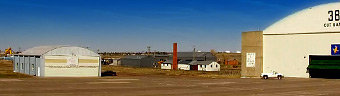
July 6th, 1942 the 2nd Air Force authorized the construction of the Great Falls Army Air Force Base in Montana along with three Satellite bases to be located at Cut Bank, Glasgow and Lewistown. Major John L. Eaton was assigned as the Base Commander over all the bases and for the most part remained at Great Falls. Each Satellite Base was assigned two permanent Staff Officers to oversee their installations. GFAAB was designated as the "352nd Base Squadron" and was policed by the "994th Guard Squadron." Lt. Claude D. Stanley and Lt. Bruce B. Raymond were Cut Bank's first Staff Officers. Major T. K. Meyers became Base Commander CBAAFB October 1942.
Basic plans for construction had been previously developed as many such projects were going on all over the United States. Just a few changes might be necessary to adapt to the different locations. Construction started in July of 1942 at all four locations.
Captain G. C. Cooper with previous experience on such projects was put in charge of the construction. Due to his previous and very successful performance, he was authorized to make any changes to the original plans as he deemed necessary that would benefit or speed the project along and or to improve the conditions for the flight crew training that was soon to follow. Upon reviewing some of the original blueprints, it can be seen where such changed were made.
The Cut Bank Army Air Force "Satellite" Base was located three miles southwest of town. The location was ideal as there was plenty of room for two large and long runways to accommodate the B-17's. There was also plenty of room to construct the necessary facilities to house and maintain the needed base personnel and the flight squadrons that would be arriving shortly.

The usual size of the squadrons was expected to be nine B-17's, thirty seven officers and 229 enlisted men. Outside parking was provided for Twelve B-17's and one would fit in the large hangar. The officers quarters were 100' x 20' and were to house 16 men. The enlisted mens barracks were also 100' x 20' but were to house 34 men, and in an emergency could be pushed up to 48.
Two Mess Halls were constructed both 100' x 20'. The officers mess was to seat 120 men, and the enlisted mess was to seat 500 men. The Base Dispensary was 120' x 24' and was to include quarters for the Base Surgeon. The Administration Building was also to be 100' x 20'. Base contractors were "Askevold & Ruud."
The water tower was 111' including a 100,000 gallon storage tank. The contract for the tower and tank was awarded to J. Hugo Aronson “The Galloping Swede”, a local oilfield contractor who later went on to be governor of Montana. A nineteen foot rotating beacon was installed on top of the tank.
Glacier Construction Company was awarded the contract to drill wells to provide 100 gallons per minute of water and to lay approximately 7,000 feet of six inch line to service the base. The sewer system for the base was awarded to Frank Haas. A work force of approximately 350 men was utilized to complete these parts of the project. The project proceeded very rapidly and by the end of October was nearing completion. Just minor details such as moving in furnishings were all that remained.
A "Open House" for the public was authorized for three hours on Sunday November 1st. A second "Open House" was allowed on Armistice Day November 11, 1942 when the base was officially activated and declared ready for duty. By the end of November B-17's and flight crews were arriving and training was underway.
|
|